
 Madalena Cruz-Ferreira
ISBN 9781903292, January 2010, Battlebridge Publications
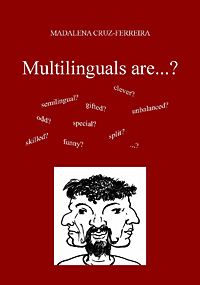
Multilinguals are people who use several languages in their everyday life. Attitudes towards them are very diverse: some consider them gifted or unusually intelligent, while others fear that they are not fully competent in any one language. This can lead to conflicting advice about multilin-gualism at home, in school, and elsewhere, particularly nowadays when awareness about multilinguals is growing wherever several languages are used, from London and Amsterdam to New York and California.
This is the first book which discusses, in lay terms, the reasons behind the beliefs and myths traditionally associated with multilinguals. It is written for the general public and is relevant for families, teachers, and everyone else who ever wondered about multilingualism. The style is light, often witty, but is founded on a thorough knowledge of all the solid academic research on this subject.
“This is a breath of fresh air in a field which desperately needs ventilation. It blows away the myths and fantasies about multilingualism, and puts in their place a perspective of sound common sense, grounded in the daily experience of living a life in which several languages form a natural part. For anyone who has ever been uncertain about multilingualism, worried about it, or misrepresented it, this lively and accessible overview is the perfect reality check.”
Professor David Crystal, author of The Cambridge Encyclopedia of Language.
“Madalena Cruz-Ferreira has crafted a down-to-earth, fun, accessible, and highly informed treatise on multilingualism. The book addresses a wide range of misconceptions about multilingualism in a humorous and entertaining way, and should be required reading for teachers, professionals, and the rest of us who work closely with groups and individuals who use multiple languages!”
Professor Jeff MacSwan, Applied Linguistics, Arizona State University.
Contents:
Acknowledgements
Multilinguals are ...?
1. It's a multilingual world, but multilinguals are the odd ones out
2. Multilinguals must have balanced languages, but one of them must be dominant
3. Multilinguals must develop one main language, but that won't let them develop other languages
4. Multilinguals have no mother tongue, because they are not native speakers of any language
5. Multilinguals can learn new languages easily, but only in childhood
6. Multilingual competence means erasing signs of multilingualism from the speech of multilinguals
7. Multilinguals don't have many languages, they have many half-languages
8. Becoming multilingual is both a drain and a strain on your brain
9. Growing up multilingual is no problem, provided you seek clinical assistance
10. In order to raise multilingual children, you must speak to them in only one language
11. Multilingualism should be encouraged, but only in languages that matter
12. Multilinguals are multilinguals because they are gifted for languages
13. Multilingualism is a boon, but also a bane, or vice versa
What are we talking about, really??
Introducing Yuti
Illustration Credits