
 University of Nebraska Press 2005
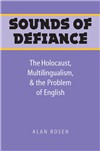
About the book : Language has frequently been at the center of discussions about Holocaust writing. Yet English, a primary language of neither the persecutors nor the victims, has generally been viewed as marginal to the events of the Holocaust. Alan Rosen argues that this marginal status profoundly affects writing on the Holocaust in English and fundamentally shapes our understanding of the events. Sounds of Defiance chronicles the evolving status of English in writing about the Holocaust, from the period of the Second World War to the 1990s.
Each chapter highlights a representative work from a different
genre—psychology, sociology, memoir, tales, fiction, and film—and
examines the special position of English with regard to the Holocaust,
supported by references to the role of other languages, including
Hebrew, Yiddish, and German. This original approach provides a new
perspective on such standard works as Eichmann in Jerusalem, The Shawl, and Maus,
while drawing attention to others largely unknown. Rosen also links
this analysis of English writing to developments in the postwar period:
the escalating production of writing on the Holocaust in English; the
increasing prestige of English as a global language; and paradoxically,
within the contexts of neocolonial and multilingual studies, the
increasingly uncertain position of English.
Author/editors: Alan Rosen is a 2004–2005 fellow at the Center for Advanced Judaic
Studies at the University of Pennsylvania and the 2005 Sosland Fellow
at the Center for Advanced Holocaust Studies at the United States
Holocaust Memorial Museum. He has published books and articles on
Holocaust writing and is currently working on a book dealing with David
Boder and Holocaust testimony.