
 What can future applied linguistics do to mitigate disadvantages for non-anglophones?
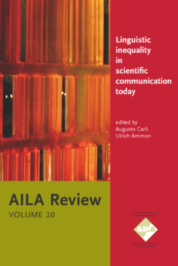
AILA Review, Volume 20
John Benjamins Publishing Company, 2008, ISBN: 978 90 272 3992 1
This volume is dedicated to the implications and consequences of the
almost exclusive use of English as the language of scientific
communication. While until the end of the Seventies of the last
century, scientific communication was characterized by a high degree of
shared multilingualism, a drastic change towards English monolingualism
has taken place from the beginning of the Eighties, at first in the
so-called hard sciences (natural sciences, medicine, technology, and mathematics) – under the threat of the ‘bibliometric measurement’ via the impact factor –
and gradually also, though still to a lesser extent, in the social
sciences and humanities. The choice of English is usually seen as
“natural” or at least “unavoidable”, without considering that it could
involve problems and be inequitable. This volume of AILA Review
presents and discusses this phenomenon and its social implications with
the support of a number of internationally known authors who outline
its scientific relevance and put forward various options of language
policy.
Click here to see the table of contents