
The issue of anglicisms easily provokes instructive reactions.
For some, systematic borrowing from English is the natural order of things, and they do not hesitate to invoke the debt owed by the French langage to the English langage since, thanks to William the Conqueror (Hasting, 1066), 50% of English vocabulary was derived from French between the eleventh and thirteenth centuries. Some people go so far as to take the cultural superiority of the American model for granted, and consider any deviant view to be reactionary.
For others, on the contrary, any borrowing is an attack on the purity of the language and must be condemned.
Between these two extremes, majority opinion shows fortunately more discernment.
Since Etiemble, much has been said and written on this subject, to the point of thinking that the subject is exhausted and that there is nothing more to say. We think the opposite.
The advantage of the plurilingual approach is that it is associated with a strong linguistic awareness and is imbued with the idea that languages are more than just tools for communication; they are real environments for life and personal development. They are more or less open cultural spaces, in dynamic relationship with each other, which is what makes linguistic and cultural diversity so rich.
It is this dynamic that we want to highlight and discuss here, avoiding the simplistic schemes mentioned above. Professor Alexandre Klimenko, Head of the Chair of Translation and Interpreting, Doctor of Letters and Professor at Vladimir Dahl University (Ukraine), has suggested a new approach to anglicisms. As early as May 2017 the OEP welcomed Alexander Klimenko's proposal and implemented it by building a dedicated site accessible at this address https://nda.observatoireplurilinguisme.eu.
How times change!
First used in medicine in the 14th century, the word "inflation", synonymous with "swelling" (inflation of a limb), derived directly from Latin, made its way into economics in the United States at the end of the 19th century and was translated into French without modification after the First World War. At the same time, its opposite appeared, with the prefix "de" being replaced by "in". It's hard to talk about borrowing or Anglicism. The two words are identical in both languages, and the copy from the Latin "inflatio" is immediate.
Today we have "shrinkflation" and "cheapflation", and it takes at least five minutes on France inter to explain the meaning of these new words, which we will describe as "emergent", without knowing whether the French will willingly adopt them.
While "inflation" simply means "rising prices" and "deflation" "falling prices", "shrinkflation" refers to a hidden rise in prices, deliberately concealed or masked by the seller who cuts quantities without changing the advertised price. "Chaepflation" is a variant of "shrinkflation", since the seller lowers quality rather than quantity, still for the same price. So we have two variants of inflation masked by the lowering, lowering meaning the reduction of quantity or the lowering, lowering meaning the reduction of quality. "Quantiflation", "quantireducflation" or "réducflation" for the reduction of quantities, or "qualiflation", "qualireducflation" or "dégradflation" would perhaps be more meaningful to a French person, but this is not certain. Is the neologism even necessary? It's good to know that the Anglo-Saxons have come up with new nouns, but that doesn't mean they should become new terms in the French language. A good-natured curiosity which can just as easily be applied to French words which come to us from all over the world.
So should we accept or not accept. 1In the end, it's all a question of usage, so we can always say "it depends" . But any citizen, before launching into Pavlovian reflexes, out of reverence, snobbery, submission, fascination, fashion, gregarious conformism, elitist differentialism - there is no shortage of qualifiers - can simply look for the right words to describe new realities, even if it means borrowing them from outside the French-speaking world.
Is it possible today to be nuanced and to avoid both blind acceptance and narrow-minded rejection?
Until now, we have found the analytical framework lacking. The great nineteenth-century historian of the French language, Ferdinand Brunot, saw two types of borrowing. Borrowing for enrichment, the one which is genuinely useful and enriches the vocabulary with new concepts, and "luxury borrowing", the one which is of no particular use, motivated by the search for a form of distinction for an individual or a social group, in Bourdieu's sense.
Some borrowings are pointless, because the words already exist, and are the manifestation of a "cultural hold". This was the case, for example, with the attempt during the COVID period to replace the expression "foyer de contamination" with "cluster", an all-purpose English term with multiple uses, which contains the idea of grouping or bundling. Scientists, communicating internationally in English, tried to impose the term. It invaded the media for months, but there's nothing to say that "cluster", which is just as suitable for designating a bunch of flowers as a network of computers, really speaks to the French. In the same way, "tracking" has been widely used to the detriment of "suivi des cas contacts", without any need other than alignment with a standard.
So there is nothing to suggest that these attempts to replace existing terms with new English terms unnecessarily, purely as a means of domination, will ultimately succeed and become part of the French language. The language has this remarkable filtering capacity, which enables it, if it is sufficiently robust and if linguistic awareness is sufficiently developed, to retain from borrowings only what is directly useful to it.
Alexander Klimenko invites us to take this nuanced approach.
Klimenko (whose first name we will omit) puts forward a number of concepts which we will examine below.
A panoramic view
First, as an analyst of linguistic influences in a variety of national contexts, he explains that France is in a class of its own in terms of the intensity of verbal anglicisation in a large number of European countries, whether in Western, Central or Eastern Europe.
"To be convinced, we need only compare this hopeful situation with a defeatist attitude in Germany, for example. Here we have come to speak of a so-called exoglossic evolution of the contemporary German language. 2Such a language situation is characteristic of a preference for an English language supposed to be more prestigious than the mother tongue, a spectacularly high level of borrowing, and derivative innovations based on English formants, consigning German formative elements to oblivion [Abresch 2005:177; Junker 2010:142].
The first signs of this trend can be seen in the use of a number of anglicisms in French media discourse, on the one hand, and on the other hand in the press language of languages such as Russian and Ukrainian. These borrowings are gradually being supplanted by French analogues and are taking root as such in these Slavic languages: angl. computer n. < fr. ordinateur n.m. printer n. < fr. imprimante n.f., angl. xerox n. < fr. photocopier n.f. e-mail n. < fr. courriel n.m., angl. fax n. < fr. télécopie n.f. tour operator n. < fr. voyagiste n. [Чередниченко 2008: 21 - 23].
Another recent example. During the second wave of the coronavirus pandemic we saw the French confinement n.m. " 1. ◊ Spécialt, méd. Prohibiting a patient from leaving the room". [Le Petit Robert 2020 (PR)] take on a new nuance of meaning 1 "The fact of not leaving one's home", whereas in Germany, Italy, as well as in Russia and Ukraine the loan lockdown has been adopted."
Linguistic awareness
Klimenko offers an initial explanation. "An in-depth study, made possible by our vast documentation, opens a window onto the formation in the collective linguistic consciousness of the French of a spontaneous norm of use of anglicisms and their French analogues (synonyms and equivalents, francizations, substitutes, including those incorporating the meanings of anglicisms). It is undoubtedly affected by the official standardisation of terminology. e It is also heir to the "French supernorm" (French being one of the most unified and standardised languages, given the extent of the intense standardising impact of good academic usage dating back to the seventeenth century), as well as traits of Frenchness in line with the national mentality (the French rational, for example).
A spontaneous norm
Does Klimenko have an idyllic vision of the French situation? Perhaps, but you have to read and listen to him.
"Speakers have a confused perception of a spontaneous norm, even though, on the whole, they are the main actors in it. As such, this norm, a phenomenon of depth, plays the role of a filter that rejects and supplants superfluous Anglicisms and welcomes consistent and coherent normalising pressure in favour of the French counterparts.
However, we are discovering particularities of a spontaneous norm that reflect a real reaction of the French language to immoderate foreign influence.
3The standard in question is made up of the usual integrated Anglicisms, irreplaceable for the time being, used without reservation and ipso facto having become fully-fledged units of the French lexicon: conventionnel , dressing, leadership, patchwork. They are often adapted by developing their semantics in French.
This standard creates non-competitive links that enrich the language, where Anglicisms become enveloped in parallel French names that are actually used: parking / car park; tennisman / tennis player; sponsor/ parrain - marraine - commanditaire.
This includes regionalisms that have been naturalised in French: week-end / fin de (la) semaine, samedi-dimanche.
The influence of Anglicisms can lead to the synonymisation of French words, bringing their semantics into line with each other: poster / affiche.
Competition between Anglicisms and their French equivalents can also lead to a stylistic distinction: overdose Fam. / surdose.
At the same time, a spontaneous norm rejects intruders from use: walkman < baladeur; businessman < homme d'affaires; notebook < mini-ordinateur, ordinateur (PC) portable (portable, mobile), portable; décade (période de dix ans) < décennie; garden-center < jardinerie; container < conteneur; cableman < câbliste.
Polysemous French words adopt the meanings of Anglicisms without confusion of meaning: false Anglicism perchman < perchiste.
The standard in question also creates links, connecting "anglicism / its French analogue" variants where competition has developed or arises:
- following efforts at official standardisation: tour-opérateur < voyagiste, autocariste, transporteur ;
- thanks to the resistance of the French rational: jumbo jet < gros porteur;
- as a result of the subordination of Anglicisms to their French analogues: сaméraman / cadreur, opérateur.
- because of the supplanting of borrowings due to a French predilection for generic words: funboard < windsurfing; tour-opérateur < travel agency (agent).
- due to grammatical adaptation (free-lance invar. - free-lances adj. and n. pl.)
A look at legal provisions, their effectiveness and language creativity
Not everyone is familiar with the Franceterme database, created under the Toubon law, which set up the system for enriching the French language. Franceterme is the culmination of this initiative, and the fact that nearly 8,000 terms and expressions are included in the database should not leave anyone indifferent.
One should also be aware that the Commission d'enrichissement de la langue française (French Language Enrichment Commission), which crowns a system that some may consider cumbersome and complex, leads to the publication of between 200 and 300 recommended terms in the Official Journal every year.
|
Year |
Terms published in the Official Journal |
|---|---|
|
2009 |
276 |
|
2010 |
247 |
|
2011 |
392 |
|
2012 |
299 |
|
2013 |
343 |
|
2014 |
243 |
|
2015 |
268 |
|
2016 |
221 |
|
2017 |
231 |
|
2018 |
215 |
|
2019 |
278 |
|
2020 |
217 |
|
2021 |
268 |
|
2022 |
235 |
That's 3,733 new words or not in fourteen years, to which the Commission has given French-English equivalents.
Compare these figures with the new words that enter the Larousse and Robert dictionaries every year, which are of the same order of magnitude.
In 2019, the newspaper Le Monde had carried out a very interesting analysis of the sources of the new words.
Here's the chart:
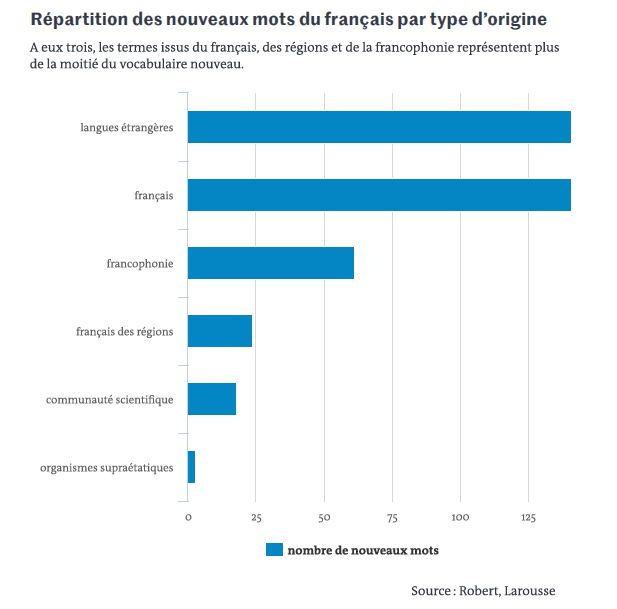
Over 55% of new words come from France and the French-speaking world, and almost 40% come from foreign languages.
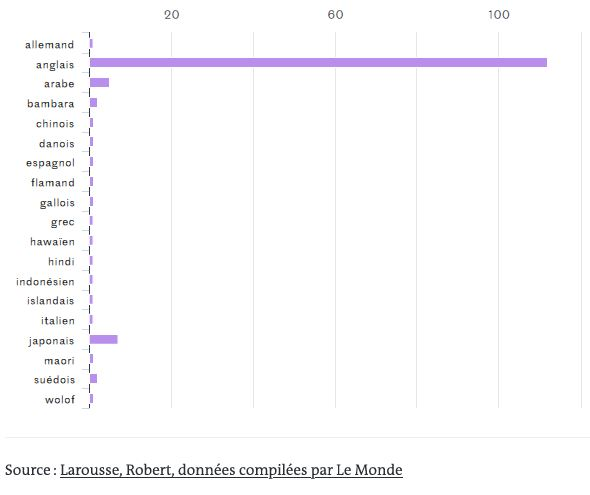
And if you want to estimate the share of English in the foreign languages, here's the result: errors of assessment are fairly easy. In its 2019 article, Le Monde put the share of English at 16.6% of new words, whereas the similar study for 2022 indicates that foreign languages provide 28% of new entries, 80% of which come from English, i.e. 22.4% of the new words, but it doesn't matter, it's the orders of magnitude that count:
The OEP website
It is in this context that the website set up by the OEP takes on its full meaning. Here is what Klimenko has to say about it:
"A new linguocultural situation that gives hope and heralds the decline of the Frenglish era is being exploited to the full by the European Observatory for Plurilingualism (OEP), whose president, Mr Ch. Tremblay, has designed and launched the "Ten Anglicisms a Month to rack one’s brains" website.
The site does not intend to reject Anglicisms in principle, but seeks to establish "a policy of peaceful coexistence" between languages. For this purpose it confers a standard-setting activity a communicative dimension on an interactive platform in a discourse that establishes a literary norm.
Like all discourse, it takes a clearly intentional direction, free from hesitation in the face of the threat of uncontrollable mass borrowing.
4We invite you to visit . Because it explains a real standard, it contains information that is largely absent from your Petit Larousse or Petit Robert. For example, the articles on integrated anglicisms have been updated to include much richer semantic structures and more precise meanings: look, star, starlette, géométrie variable (à), made in, remake, travelling and many others.
We also highlight the nature of the links (non-competitive = synonymous or competitive to one extent or another) or establish the links, connecting anglicisms to their French analogues.
In the event of competition, by encouraging this contest, we are committing ourselves to a standardisation process that will consolidate a real literary standard.
We hope that the site will be of real interest to the general public. Instead of normative qualifications imposed from above, it presents in an enlightening way a wealth that the French have accumulated. This does not affect the confidence of the speakers.
We would like to add a few details to this presentation.
The method, the corpus
This is done by listening to the media and reading the newspapers. When an anglicism has been identified, a search is carried out on a corpus consisting of the entire collection since 1948 of the newspaper Le Monde, and the archives of Le Figaro and Le Point. A search is also carried out using a research engine to count the number of occurrences and extend the field of journalism.
This corpus is obviously incomplete and socially marked. In particular, we need to reach audiences outside the traditional information channels, especially high-intensity users of social networks, taking into account the fragmented nature of these networks.
Special attention to emerging words
Unlike dictionaries, which wait until an anglicism has been adopted by a wide range of people before including it among the new words of the year, part of our research involves detecting emerging anglicisms that are likely to become established in usage. There is a risk involved, as these emerging anglicisms may never become part of usage. The proportion of potential anglicisms compared with anglicisms confirmed by usage is difficult to estimate, but is probably very high, as these anglicisms are much more numerous than confirmed anglicisms.
Special attention to unidentified words in Franceterme
5The idea is that anglicisms not taken into account by Franceterme should be submitted to the Franceterme ideas box . An interface is provided for this purpose in the site menu.
An openness to other languages, particularly Italian and German.
There are sites in Italy and Germany that are dedicated to identifying anglicisms. 6The OEP has begun working with an Italian site and hopes to develop a similar collaboration with Germany.
Call for entries
It's clear that maintaining a site like "Ten anglicisms a month to get you thinking" requires a lot of human resources, especially as creating descriptive sheets is no easy task. So we're calling on people of goodwill to help us set up a real collaborative workshop to keep the site up and running.
1See David Castello-Lopès' question of 5 March 2024 on Franceinter: https://www.radiofrance.fr/franceinter/podcasts/la-question-de-david-castello-lopes/la-question-de-david-castello-lopes-du-mardi-05-mars-2024-3319867
2ABRESCH J. (2005). th "The pronunciation of Anglicisms and English proper names in German: a corpus study", Proceedings of the 16 conference on electronic speech signal processing (ESSP), Prague, 2005.
JUNKER G.H. (2010) Der Anglizismen-Index, Gewinn oder Zumutung, Paderborn, IFB-Verlag.
3 Each example in the article invites you to consult the sheets on the "Ten Anglicisms..." site, which is already up and running at http://nda.observatoireplurilinguisme.eu/.
4https://nda.observatoireplurilinguisme.eu