
Final general communiqué
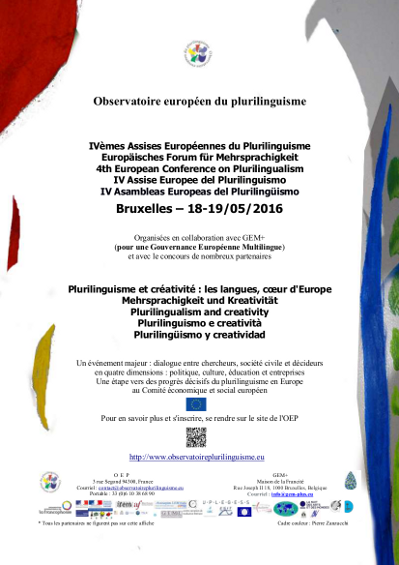
The 4th European Conference on Plurilingualism took place in Brussels at the European Economic and Social Committee on 18 and 19 May 2016 around the general topic “Plurilingualism and creativity”.
Whatever the trend to standardise communication by means of a single language, the world is multilingual and the benefits of plurilingualism are unique in the cognitive, relational, social and economic fields.
The dominant theme of the Conference was creativity, not only because creativity is intrinsically linked to language, but also because it is through “creativity” that we can meet the many challenges posed by diversity in the political, economical and social, educational and cultural fields.
From this perspective the linguistic issues have thus been examined in the institutions and political systems, and in the educational, economical and cultural fields. In these four thematic areas, the Conference has identified key ideas leading to as many recommendations intended for the European authorities and the rulers of the member States, and more generally to the civil society actors.
On the political level, there is no democracy if the populations cannot be addressed in their own language : this is a fundamental responsibility of the rulers and primarily of the European institutions.
On the cultural level, monolingualism kills cultures and oppresses individuals, whereas plurilingualism is a source of enrichment and progress.
On the economical level, plurilingualism is a reservoir of productivity and long-term development and on the social level, plurilingualism gives meaning and favours dialogue and mutual understanding.
On the education level, plurilingualism is the basis guaranteeing long-term cohesion of Europe and allowing the citizens personal and relational fulfilment.
These ideas need to be translated into concrete steps :
Education
1. Prefer plurilingual and cross-cultural education so as to reinforce the ability to learn languages throughout life.
2. Revive the model 1+2 (2 languages besides the teaching language) adopted in 2002 at the Barcelona European Council to improve the language proficiency of Europeans.
3. Apply the model 1+2 from nursery school to further education.
4. Diversify the teaching of languages by learning at school a language other than English or by promoting two foreign languages in primary school.
5. Oppose an unrestrained counter-productive anglicisation in higher education, and develop in universities plurilingualism which is the only way to guarantee the development of the diversity of cultures, the respect of differences and democracy.
6. Make it impossible for English to replace the local language in higher education, research and scientific publications. If other languages are used, it should in a plurilingual context excluding the hegemony of a single language.
7. Act with the scientific institutions so that plurilingualism is taken into account as a strategy.
Politics
8. Better explain the negative consequences of monolingualism (and the benefits of plurilingualism) on the political and social levels.
9. Diversify the actual use of languages in the European Commission and all the European institutions and their agencies.
10. Choose integral multilingualism on the platform europa.eu (website of the European institutions) and make it a communication tool with citizens.
11. Encourage cooperation between linguistic areas in Europe to elaborate strategies so as to protect and promote linguistic diversity at an international level.
12. Outline language policies in Europe in the double dimension of a right to the language of the welcoming country and the learning of the languages of migrants.
13. Develop a sectoral policy to support media for a plurilingual technological innovation on the internet.
Culture
14. Create a prize for non-European authors (writers, scientists or translators) who have made a major contribution to European culture.
15. Allow the European publishers to receive special grants for translation (between European languages or to a European language).
16. Support the publication of bilingual translations because they respect plurilingualism and help learning.
Economy and society
17. Reinforce the idea that languages are a central factor of efficiency in international management.
18. Enlarge the linguistic, cultural and managerial dimension to all the management trainings.
19. Act with certification bodies to include the linguistic, cultural and managerial dimensions in the training frameworks.
20. Support a plurilingual view in all the managerial trainings including the engineering trainings.
Communiqué for the topic « Education »
Communiqué for the topic “Politics”
Communiqué for the topic “Culture”
Communiqué for the topic “Economy and society”
Download