
Communiqué for « Education »
Plurilingualism in education
The issue of languages is crucial in the field of education and research because the decisions taken today will have mid-term and long-term structuring effects in two of the key sectors of our modern globalised societies, namely the future of their youth and the production of knowledge necessary to their cultural and economical development. Yet it must be noted that nowadays linguistic policies are implemented in the educational system, from nursery school to higher education, without any real reflection, generally in the direction of an hegemony of English. It is therefore urgent to take stock of the current situation and to think about what kind of future we wish. The European Conference on Plurilingualism wishes to contribute to this debate and more particularly its second topic “Education, higher education and research”.
This topic has been divided into five round tables.
The first round table, entitled “Taking into account language and cultural plurality in education and training”, showed by the contributions of many researchers practising at all levels that the great variety of languages and cultures present in the European educational structures cannot be ignored and that it is important to acknowledge and value it so as to make it an asset for the pupils’ school success, and thus for their future social success. The gain would not be individual only but also social, it would reinforce the ties within Europe. This is why the European Conference on Plurilingualism wishes that the diversity of languages be taken into account within the educational system.
For the linguistic diversification to become real, it should be integrated into the educational pathways proposed by the European educational systems and into teachers’ trainings. The Conference is in favour of a pathway that would include several languages as early as primary schools, with continued learning into secondary school and higher education.
But how can “Plurilingualism in training” become a reality ?” This was the topic of the third round table. Several approaches are possible, from classical teaching of language awareness to cross-cultural learning at school or outside school, to online courses or cross-comprehension techniques that rely on previous knowledge in one language to learn others of the same linguistic family, for example the Romance, Slavonic or Germanic languages. The Conference is in favour of a diversity of educational approaches in the learning of languages.
Plurilingualism is an extremely important issue in the building and transmission of knowledge, particularly in the context of “the globalisation of higher education” which was the topic of the fourth round table. Restricting international teaching to one or two languages means a great impoverishment in the acquisition and production of knowledge. Rather than promoting monolingual English, it would be best to strengthen the existing international languages and to allow other languages to acquire this international status. The Conference is in favour of plurilingualism in higher education and research, the only way to guarantee the development of the diversity of cultures, the respect of differences and democracy.
Then there is the major issue of the “linguistic policies of universities”, the topic of the fifth round table. Until now, these policies have depended more on fashion trends than on serious reflection. Many European universities have succeeded in implementing a rich and diversified linguistic policy but difficulties are numerous, at once institutional, administrative, educational and ideological. The necessity to teach and do some research first in the local language must be asserted, so as to maintain the richness and thus the attractivity, then in a variety of languages because scientific creativity is narrowly linked to plurilingualism. English can play the role of a lingua franca, but should not be allowed to replace other languages in higher education and research. The European Conference on Plurilingualism believes that the time has come to create a legal framework that could structure language policies in universities.
Propositions
1. Prefer plurilingual and intercultural education so as to reinforce the ability to learn languages throughout life.
2. Revive the model 1+2 (2 languages besides the teaching language) adopted in 2002 at the Barcelona European Council to improve the language proficiency of Europeans.
3. Apply the model 1+2 from nursery school to further education.
4. Diversify the teaching of languages by learning at school a language other than English or by promoting two foreign languages in primary school.
5. Oppose an unrestrained counter-productive anglicisation in higher education, and develop in universities plurilingualism which is the only way to guarantee the development of the diversity of cultures, the respect of differences and democracy.
6. Make it impossible for English to replace the local language in higher education, research and scientific publications. If other languages are used, it should in a plurilingual context excluding the hegemony of a single language.
7. Act with the scientific institutions so that plurilingualism is taken into account as a strategy.
Communiqué for the topic “Politics”
Communiqué for the topic “Culture”
Communiqué for the topic “Economy and society”
Download
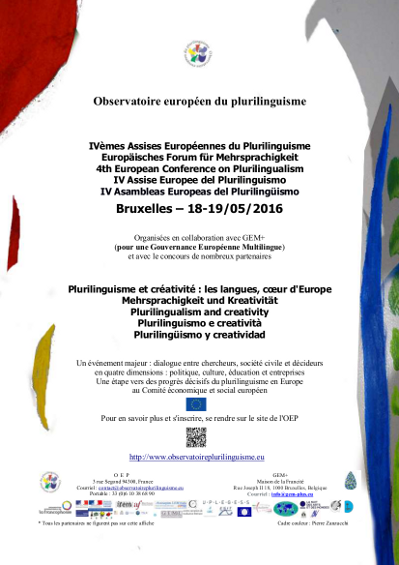
4th European Conference on Plurilingualism - 2016- Brussell